
Trees provide shade, beauty, privacy, and homes for wildlife. A healthy tree may remain part of a property for decades, so removing one should not usually be the first response to a problem. Pruning, soil care, support systems, or pest treatment may sometimes extend a tree’s useful life.
There are situations, however, when keeping a tree creates an unreasonable risk. Understanding the warning signs can help property owners decide when removal may be necessary.
The Tree Is Dead
A completely dead tree cannot recover. It will slowly become weaker as insects, moisture, and decay break down the wood. Branches may fall without much warning, and the entire trunk could eventually fail.
A dead tree located near a home, driveway, sidewalk, road, playground, or utility line should be evaluated quickly. In an isolated natural area, it may sometimes remain as wildlife habitat. Location matters because a tree is mainly dangerous when people or property are within its possible falling zone.
The Trunk Has Serious Structural Damage
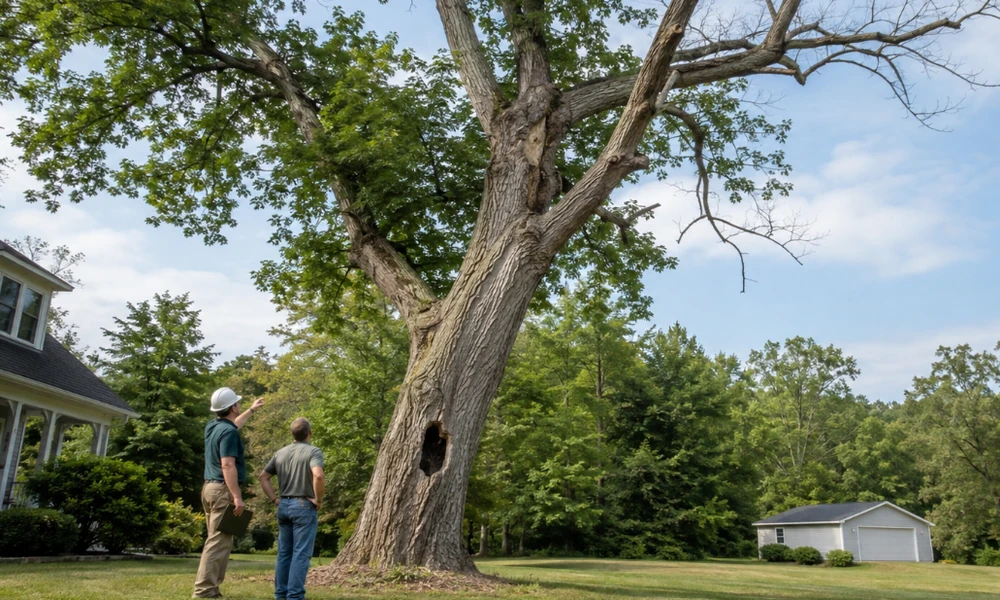
Cracks, large cavities, missing bark, and deep areas of decay can weaken the trunk. Not every hole means the tree must come down. Trees can sometimes remain stable despite internal damage.
The concern becomes greater when decay affects a large portion of the trunk or appears near the base. Long vertical cracks, splitting between major stems, and visible movement during ordinary wind may also suggest instability.
Mushrooms growing around the base can be another warning sign. They may indicate decaying roots or wood below the soil, though proper identification is important before reaching a conclusion.
The Root System Is Failing
Roots hold the tree upright and supply water and nutrients. Unfortunately, most roots are hidden underground, making damage difficult to see.
Warning signs may include lifting soil, exposed broken roots, sudden leaning, thinning leaves, or dieback throughout the canopy. Construction can also injure roots when soil is removed, compacted, or covered. Trenches dug for utilities may cut through major supporting roots.
When a large part of the root system is damaged, the tree may not be able to remain stable. This can be especially serious after heavy rain softens the ground.
The Tree Has Developed a New Lean
Some trees naturally grow at an angle and remain stable for many years. A new or quickly increasing lean is different. It may mean roots have broken or the soil can no longer support the tree.
Cracked ground, raised soil, or exposed roots on the side opposite the lean can point to possible failure. If a leaning tree could reach a building, road, or gathering area, people should stay away until it can be examined.
Disease or Pests Cannot Be Controlled
Many diseases and insect problems can be managed, particularly when found early. However, some infections spread through the trunk, roots, or vascular system and eventually kill the tree.
Removal may be recommended when treatment is unlikely to work, the tree has already lost much of its canopy, or the problem could spread to nearby trees. Correct diagnosis matters. Similar symptoms may come from drought, poor soil, root injury, or several problems happening at once.
Storm Damage Has Left the Tree Unstable
A tree may survive the loss of a few branches. More extensive storm damage is harder to manage. A split trunk, broken main leader, uprooted root plate, or loss of most of the crown can make recovery unlikely.
Storm-damaged trees can be unpredictable. Hanging limbs and broken trunks may shift suddenly, so homeowners should avoid standing beneath them or attempting removal without proper equipment.
The Tree Creates an Unavoidable Hazard
Sometimes a tree is healthy but located where its roots or branches cause a serious problem. Roots may damage a foundation or critical utility, while the trunk may interfere with an essential construction project.
Removal should still be considered carefully. Root barriers, design changes, or selective pruning may solve the issue. If no reasonable alternative can protect the property and maintain the tree safely, removal may become necessary.
Get a Careful Assessment
Appearance alone does not always reveal a tree’s condition. A green canopy can hide internal decay, while a hollow tree may be more stable than it looks.
Before removing a mature tree, get a qualified risk assessment when circumstances allow. A proper inspection considers the species, structure, health, surroundings, and possible targets. The goal is not simply to remove trees. It is to determine whether a tree can remain safely or whether removal is truly the responsible choice.
This post was written by a professional arborist at Arborist Largo FL. Robert Miller is the owner of Arbor Wise Professional Tree Care, a locally owned and operated tree service company that offers superb lawn care by the most experienced Arborists. Arborwise Tree Services is a tree removal company that offers stump removal, tree pruning, stump grinding, fertilization, and tree restoration. We have an extraordinary lawn care industry notoriety covering the Pinellas county area.