
Most people picture roof trouble arriving from above, as rain driving under a loose shingle or a branch punching through during a storm. In the river towns along the Ohio, though, plenty of roofs start failing from underneath, inside an attic that nobody has opened in years, where warm household air meets cold wood and slowly turns to water.
Ask any roofing company in South Point that tears off old roofs between Proctorville, Huntington and Ashland, and the crews will describe the same scene. The shingles look tired but intact, yet the plywood underneath comes up soft, stained and black along the north slope. The team behind nestroofing.net sees enough of it that their free inspections cover the soffit and fascia along with the shingles, since the eaves are where an attic is supposed to breathe in.
It Starts as a Stain Nobody Can Explain
The first clue usually shows up in a bedroom or hallway ceiling. A brownish ring appears, yet it never seems to grow after a rainstorm. Sometimes it shows up on a clear, cold morning instead, which makes no sense to the homeowner and sends them hunting for a plumbing leak that isn’t there.
What is often happening is something inspectors call attic rain. On cold nights, moisture in the attic air freezes into a layer of frost on the underside of the roof deck and on the sharp tips of roofing nails poking through. When the sun warms the roof the next day, that frost melts and drips onto the insulation, then into the drywall below. Nail pops in the ceiling, small round stains spaced at regular intervals and paint that bubbles near the exterior walls all trace back to the same cycle.
Up the Hatch With a Flashlight
A short trip into the attic on a winter afternoon tells most of the story. The underside of the roof deck should look like plain, light colored wood. In a struggling attic it looks very different.
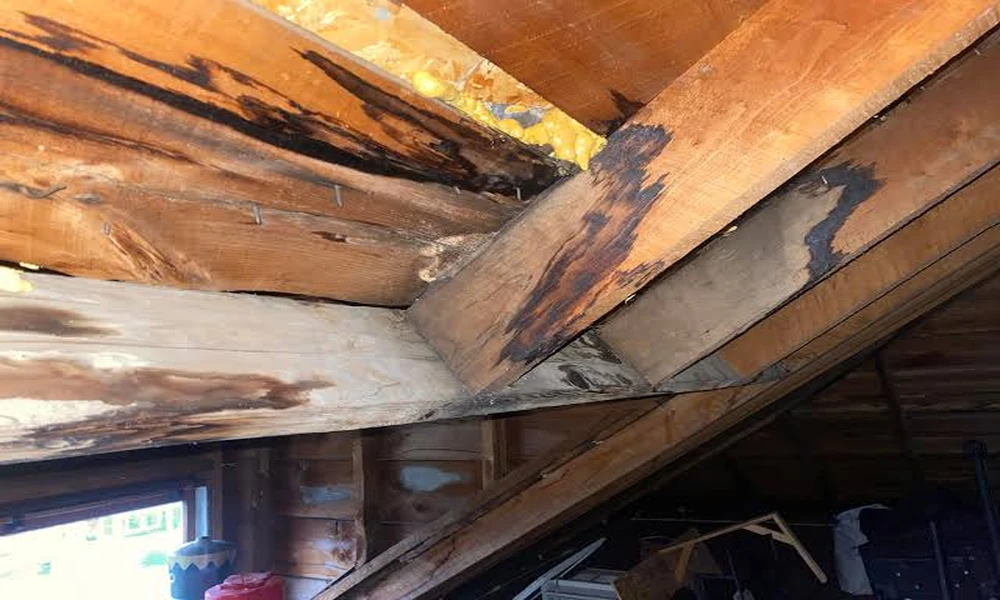
The sheathing turns gray or black, usually worst on the north facing slope that never gets enough sun to dry out. Nail tips wear little caps of rust, or frost on very cold days. Insulation feels damp or looks matted and compressed, which cuts its value sharply. A musty smell hangs in the air, and in bad cases patches of mold spread along the rafters near the eaves. The deck itself may sag slightly between rafters, a sign the plywood layers have started to separate.
None of this is visible from the yard, which is exactly why it goes unnoticed until a reroof uncovers it and the estimate grows by several sheets of new decking.
Where All That Water Comes From
A family of four puts several gallons of water into the air every day through showers, cooking, laundry, houseplants and simple breathing. Homes near the river carry an extra load from damp basements and crawl spaces, where ground moisture rises into the living space. Warm air holds that moisture easily, and warm air rises.
The problem begins when that air finds its way into the attic. Ceilings are full of small openings that most people never think about.
- Bathroom fans that were simply pointed into the attic instead of ducted through the roof or a wall, which is far more common than it should be.
- Recessed can lights that leak air around their housings.
- The attic hatch or pull down stairs, often with no weatherstripping at all.
- Gaps around plumbing vent pipes, chimneys and electrical wires passing through the top plates of walls.
- Kitchen range hoods and dryer vents with loose or disconnected ductwork.
The University of Nebraska extension service publishes a moisture source checklist that flags the exhaust fan issue specifically, and it is one of the first things a careful inspector checks.
Air In Low and Out High
Ventilation exists to carry away whatever moisture slips past the ceiling. A working system is simple in principle. Cool outside air enters through vents in the soffits under the eaves, travels up along the underside of the roof deck and exits through a ridge vent or roof vents near the peak.
Building codes generally ask for one square foot of net free vent area for every 150 square feet of attic floor, or one per 300 when the vents are balanced between high and low positions. Many older homes in Lawrence County and across the river were built with far less, and decades of changes have made things worse. Solid soffit panels get installed over the original vented ones. Painters seal vent openings shut. Thick blown insulation gets pushed right up to the eaves without baffles, blocking the intake path entirely.
Mixing vent types can backfire too. A ridge vent paired with gable vents or a powered attic fan can short circuit the airflow, pulling air from the nearest opening instead of from the soffits and leaving the lower attic stagnant.
What the Shingles End Up Paying
Moisture damage to the deck is only half the cost. An attic that can’t breathe in winter also bakes in summer, often climbing well past 140 degrees on a sunny Ohio Valley afternoon. That heat cooks asphalt shingles from below, speeding up granule loss, blistering and curling. Roofs that should last 25 years start looking worn at 15.
Shingle manufacturers know this, and most of them tie their warranties to proper attic ventilation. A claim on a prematurely failing roof can be denied if the inspector finds blocked soffits or no exhaust at all. Ice dams are less common here than farther north, but the January cold snaps that hit the Tri State every few years can still produce them on poorly vented roofs, sending meltwater back under the bottom courses.
Fixing It in the Right Order
The instinct is to add more vents, but experienced builders treat ventilation as the last step rather than the first. Sealing the air leaks in the ceiling comes first, because every gap closed means less moisture reaching the attic in the first place. Rerouting bathroom and kitchen exhaust to the outdoors comes next. Only then does it make sense to rebalance intake and exhaust, opening up the soffits, adding baffles and cutting in a continuous ridge vent.
The most efficient time to do all of it is during a roof replacement, when the deck is exposed, damaged sheathing can be swapped out and a ridge vent can be cut cleanly along the peak. Even without a new roof on the calendar, though, a winter look into the attic costs nothing but a few minutes and a flashlight. Dry, pale wood and clean nail tips mean the house is breathing well. Dark sheathing and frosted nails mean the roof is wearing out from a direction most people never think to check.